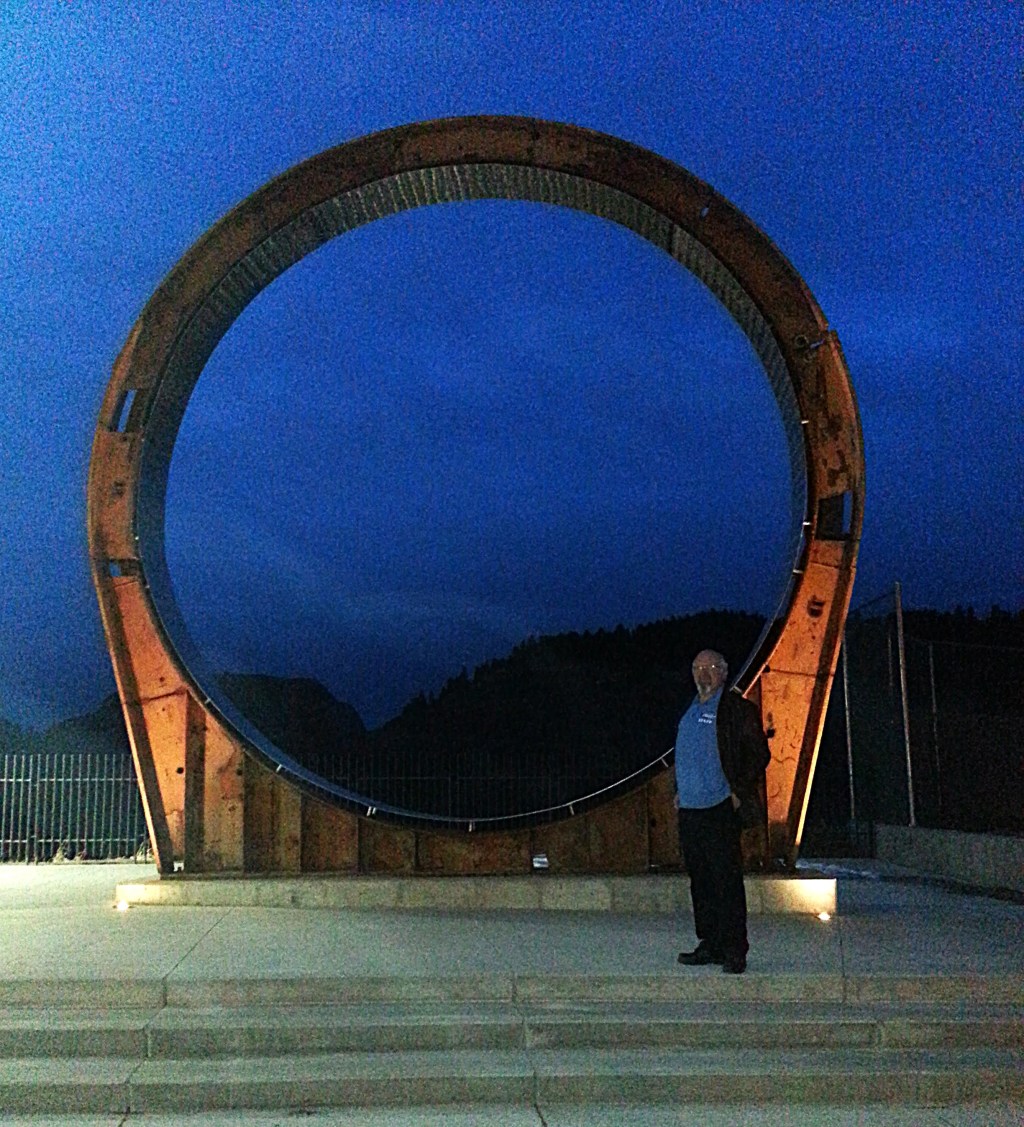
Chris standing in front of a ring from the Davis tank.
THE STORY OF HEAVY WATER
By Chris Chiller
In A Ghost in the Tide, book #11 in the Admiral Inn Mysteries series, discovery of the body of a young woman led to the recovery of scattered files from two banker boxes. Some files were stuck in the vegetation around the ravine containing the woman’s wrecked car. Some were blown down the ravine and into the Atlantic. June Faust, former treasury agent, recovered all she could and began drying and recording the pages to try to understand where this woman was going with these papers.
Working with Jeff Horsley, also a retired Treasury agent, June begins to see that there was a shipment of heavy water that failed to be delivered to The Canadian physics experiment known as SNO. More about SNO later, but first: What even is Heavy water? What is it for?
What is Heavy Water?
Let’s start with a short digression to your second week of Chem class in high school. Atoms are composed of three basic particles. Protons have a positive charge, electrons have a negative charge, and neutrons have no charge. The number of protons in the nucleus generally dictates the number of electrons in ‘orbitals’ around the nucleus. The number of protons also dictates which element the atom is part of. Atoms can, but don’t have to, have neutrons nestled alongside the protons in the nucleus. When they do, we call them isotopes of whatever element they are attached to.
Deuterium is an isotope of Hydrogen. Heavy water is known among physicists as Deuterium Oxide, denoted as D2O. It looks like the familiar notation for water, H2O. That is appropriate because exactly like water, Deuterium Oxide is two isotopic hydrogen atoms bonded to an oxygen atom. Deuterium atoms each have 1 neutron along with the proton in their nuclei. This almost doubles their atomic weight. This makes the heavy water more dense than light or natural water. That density difference makes the D2O boiling point a little higher at 101.4oC or 214.5oF.
Heavy water is principally used in Nuclear power generation facilities. All the heavy water in use was separated from the water we are familiar with. About 1 in 6400 atoms of water is a heavy water atom. Each of the separation methods currently in use are energy intensive, making heavy water much more valuable than light water, though there are more light water reactors than heavy water reactors because of the difficulty in getting sufficient D2O to surround the core and control the reaction.
Fission reactors work by starting a chain reaction in which one fission event releases a single neutron to collide with, and be absorbed by, an adjacent nucleus for a subsequent fission event. The nucleus will then become unstable and will split into two lighter fission fragments. The split ejects 2 or 3 fast neutrons as well as fission fragments, elemental atoms that carry a lot of kinetic energy. As the fragments collide with surrounding materials including heavy water around the reactor core. Those collisions produce heat. A lot of heat. That heat in turn generates the steam which powers a turbine to generate electricity without putting anything into the air except excess steam.
This works because the fuels generally used in a fission reaction have lots of excess neutrons. Natural Uranium(238U), for instance, has an atomic number of 92, 92 protons and 92 electrons. Its atomic weight is around 238, which means it has an additional 146 neutrons in its nucleus. Fissile products are varied, but typically in a light water reactor the 238U fuel is enriched with Uranium-235(235U) atoms that can split to produce an atom of barium, an atom of krypton and 2 to 3 fast neutrons. Fast neutrons are so energy dense that they are prone to produce a runaway reaction, and need some of the energy transferred away such that they become thermal neutrons.
The way nuclear particles are arranged affects the size of the target they offer to those high energy neutrons. We call that target size the cross section of the nucleus. Light water presents a cross section, a target, 600 times greater than heavy water. In practical terms that means light water will absorb a lot of neutrons converting one of the hydrogen atoms into deuterium. That is one less neutron to start the next fission event.
Heavy water, on the other hand, already has a paired neutron and an absorption to produce 3H tritium is not favorable, though it does happen and build-up must be managed. On the other hand, neutron collisions will be a bit like the break in billiards. A fast neutron is like the cue ball and the heavy water is D2O in a rack arrangement. You might have seen the cue ball stop and spin in place after scattering all the balls in the rack. In a somewhat similar way, the heavy water takes away energy in collisions from the neutron. A neutron is reflected back toward the uranium core like a ball which has hit the wall in a Squash court. It will travel until it encounters a nucleus and triggers a fission event.
What this means is that a heavy water fission reactor can use natural Uranium without enrichment. Separating heavy water from natural is much safer than enriching Uranium and does not leave radioactive waste. The heavy water used for mediation and cooling does accumulate 3H over time and must be managed during recycling. A typical heavy water fission reactor would need 450-500 metric tonnes of D2O for the mediating and cooling systems. That works out to about 110,000-130,000 US gallons of water. (Canada uses the Imperial gallon which contains 5 quarts of water.)
The Davis Experiment
The heavy water in the Ghost in the Tide was meant to go to SNOLAB in Canada. The SNOLAB experiment needed 1000 tonnes of heavy water to fill a 12 meter (about 40 feet) diameter acrylic sphere. Most of the D2O was loaned to the experiment by Atomic Energy Canada Limited. The experiment was necessary because a couple of Brookhaven National Laboratory Physicists in the 1960’s began working on neutrinos and determined that it might be possible to collect evidence that they existed and that there was a stream of them coming from the sun.
John Bahcall was a theoretical physicist working on a model of the fusion reaction that produces the light and ‘heat’ from our sun. Each fusion of hydrogen protons which ultimately produces 4He Helium and in the process releases a neutrino.
The energy balance can be used to get a reasonable estimate of how many reactions must be happening and hence how many neutrinos must be passing through every square centimeter per second on the daylight side of the earth. Currently the best estimate is about 65 billion. Per Second. Take a moment to guess how many have passed through you as you read this sentence. I’ll help you: the average human has between 15,000 and 20,000 square centimeters of surface. How many ? Yeah, that’s a really big number!
Reactions in which 3H collides with 4H to produce 7Be(Beryllium) which in turn captures a free proton to raise its atomic number from 4 to 5, making 8B (Boron). This is an unstable atom, and shortly flips the proton into a neutron to achieve stability. In that process a positron,(an anti-electron) is released along with the highest energy electron neutrino.
In the 1950s physicists’ conventional thinking was that the flux of neutrinos from the sun was much much less than we now know it to be. The assumption was that the sun was not hot enough to produce detectable high energy neutrinos from 8B decay. Bahcall made a carefully detailed model of the solar reaction which showed theoretically that 8B produced neutrinos could be detectable at an industrial scale. This was a first , and the mechanics of how to detect were worked out by Dr. Ray Davis, a Brookhaven Radiochemist.
Bahcall collaborated with Davis to devise an experiment that would produce a result if a neutrino collided with a nucleus. Chlorine is a good candidate because almost 25% of natural abundance chlorine has an atomic weight of 37, that is 20 neutrons. The cross section is large enough that Davis was confident that the collision was possible, and the energy threshold needed to flip a neutron into a proton could come from a neutron collision. 37Ar (Argon) is unstable with a half-life of only 35 days before it decays by electron capture, flipping a proton back into a neutron and becoming 37Cl (Chlorine) again.
This last decay produced electrons and x-rays of known quantities specific to a 37Ar decay and physicists of the time were able to capture the signals effectively giving Davis a count of how many neutrino collisions were happening. Such a detector would only be sensitive to electron neutrinos of the highest energy.
Bahcall knew that the energy in a Hydrogen to Helium reaction in the sun would also be lower than the threshold needed, so he chose a reaction which was still plentiful but less common, 8B decay which produces the highest energy neutrinos. That also reduces the number of these neutrinos to about 2/100 all solar neutrinos. Or less, because the number of fusion reactions that produce boron is sensitive to temperature. A 1% change in solar core temperature would produce about a 25% change in how many high energy neutrinos are coming from the sun.
Bahcall and Davis built a demonstrator at Brookhaven and used Perchloroethylene (C₂Cl₄), dry cleaning fluid, as the target. Davis set up tanks near Brookhaven’s carbon block research reactor. The fast neutrons leaking out of the core were energetic enough to produce the 37Cl to 37Ar transition and he was able to show he could capture and count the Argon atoms effectively. He also showed that the tanks would count nothing from the anti-neutrino flux coming through the shields around the core. The energy from anti-neutrinos was too low. This meant that he would be able to shield the big tank experiment from lower energy particles and only count the electron neutrinos. Physicists call this shielding the “veto”. What he hadn’t shown yet is that a solar neutrino could induce the desired transition, and even more interesting, were detectable neutrinos even coming from the sun?
Having proved that his plan would work if only deep underground, shielded from fast neutrons, a search for a place to locate a full scale experiment began. In 1965 workers at the Homestake mine in Lead, SD started blasting and removing rock to create a chamber at the lowest level the mine could reach from the surface. They were 4,850 feet, nearly a mile, under dense rock and relatively far from the gold-bearing ore the mine was removing.
Later that year, the tank sections meant to hold the perchloroethylene were lowered down to the ‘Davis Cavern’ and assembled into a 20 foot diameter x 48 foot long vessel capable of holding 100,000 gallons of liquid. Filling with perchloroethylene was accomplished by July 1, 1966. Next was the veto to prevent fast neutrons, products of decay in the rock around the chamber, from colliding with chlorine in the tank. The Veto amounted to 300,000 gallons of water, about half the capacity of an olympic sized swimming pool. After testing the experiment was commissioned to start taking data in early 1968.
To get the small number of 37Ar Davis and Bahcall expected, Davis bubbled Helium gas through the tank about every 60-100 days to sweep the Argon up and out. The gas was routed through a frozen(77oK, -321oF) charcoal filter which trapped the Argon but let the helium flow on through. The filters were periodically thawed out and the argon captured and run into a small tank, then left to count the number of emitted electrons from the Argon decays. Typically, this would yield 10-20 detected atoms per 150-200 extracted. Tiny, but the known decay rate and time interval allowed Davis and Bahcall to calculate the flux of neutrinos.
Bahcall posited that the sun’s production of neutrinos is constant and with a known decay curve, the measured decays could produce a good calculated estimate of the number of 8B neutrinos streaming through the 4850 feet of rock to hit the chlorine nuclei per second. Davis calculated about 2 million neutrinos per square centimeter per second. This was a radical change in physics since conventional thinking was that he would detect no or many fewer neutrinos. His result changed the ideas about the temperature of the sun’s core and won Davis the 2002 Nobel prize in Physics.
But there was a problem. Bahcall’s calculations were proved right except for one nagging detail that had to be resolved. Bahcall had calculated a solar neutrino flux of more than 5 million neutrinos per square centimeter per second. The detector had run for 26 years and had been checked and rechecked. Where were the rest of the neutrinos? Had Bahcall miscalculated?
By now, you, dear reader, are probably wondering what all this has to do with the Admiral Inn Mysteries. In the early 90’s AJ Alanson was an undergrad who volunteered to go underground to work on some routine maintenance on the tank. Years later she returned to work on the LUX dark matter search located in the cavern that had been carved out for the Davis experiment and very briefly with the LZ experiment planning which has succeeded LUX and may have detected dark matter.
Kamiokande II and SNO
Physics needed a different way to observe the neutrinos coming from the sun to resolve the controversy among alternate theories as to why the detected neutrino flux did not match the expected. They ranged from “Bahcall was just plain wrong,” to Davis missing almost ⅔ of the neutrinos he should have seen to neutrinos that might decay into lighter particles in their journey from sun to earth. I recall reading a magazine article that quoted some physicists who said that the lack of expected neutrinos implied the possibility that the reaction at the sun’s core had stopped and that the sun might wink out at any moment. It was kind of a proto clickbait article, but it scared the young me enough to start a lifelong interest in physics.
Enter the strong physics groups in Japan. The Japanese physicists already had an experiment in a mine looking for proton decay. They had built a 52-foot diameter by 52 feet tall stainless steel tank, mounted 948 photomultiplier tubes inside and filled the tank with 3000 tonnes of purified light water. After two years of operation, the detector was reassigned to search for solar neutrino interactions. It was engineered to detect the same 8B neutrinos Davis was still collecting data on in South Dakota.
This was a step forward from the Davis experiment because a Cherenkov radiation detector did not rely on neutrino collisions with a nucleus, only a collision with an electron. That collision hits the electron hard enough to send it flying faster than light travels in water. As that charged particle barrels through the liquid, its electric field tugs at the surrounding molecules, polarizing them in a wake that can’t relax fast enough. Those tiny disturbances pile up coherently, forming a shock front of blue light — a cone — which appears as a ring across the photomultiplier tubes. The sharpness or fuzziness of the ring are artifacts of the amount of energy in the inciting particle.
Kamiokande II could also veto signals from other particles based on the specific energy that the Davis experiment had derived. A Cherenkov detector could also detect the general direction from which the neutrino had come. Kamiokande II could detect each flash of light signalling a solar neutrino. These were all pieces of information that the Davis experiment just could not offer. What was shown after the run from 1985 to 1990 was an image of the sun produced by overlaying all the neutrino rings recorded. This stopped speculation that the signals could have come from a cosmic background and hence Bahcall’s solar model was basically correct.
The fly in the ointment was that Kamiokande II measured about 2.8 million neutrinos per square centimeter per second. It only moved up from almost a third of Bahcall’s prediction to just over a half. A different sort of experiment was needed. The successor to Kamiokande II called Super Kamiokande was built to look at neutrinos from cosmic ray collisions with the upper atmosphere around earth and is an interesting read but while it provided intriguing data suggesting neutrinos oscillate into three forms, it did not show ratios or other characteristics. We shall move on to the experiment that did show ratios and that Bahcall’s numbers were not farfetched.
The SNO experiment was located in a nickel mine in Canada,(not the coins, the metal), 2 kilometers deep, about a mile and a quarter. AJ and I had a lot of depth-envy while we worked in the Davis cavern when visitors from SNOLAB or Kamiokonde came for conferences. That aside, the experiment brings us back to the beginning because SNO used heavy water to get three distinct neutrino data points.
The SNO experiment was a 20 feet in diameter geodesic acrylic sphere with 1000 tonnes of D2O inside, 9600 photomultiplier tubes outside and surrounded by 7000 tonnes of light water which completely filled the chamber that had been blasted out for the experiment.
As with light water, D2O will produce Cherenkov radiation the same way Kamiokande II did with electron neutrinos as the 8B neutrinos had been renamed. A collision with the nucleus by any of the three neutrinos will also release a neutron which can be captured in an 3He proportional counter. There is a characteristic gamma released in each of these collisions. The electron neutrinos are counted one by one so the detector is able to show the ratio of electron neutrinos to the total number of neutrons released which turned out to be ⅓. The discrepancy with Bahcall’s calculations was solved by using heavy water. And the evidence that neutrinos oscillate after emission became the likeliest explanation.
Neutrino Questions Still to Investigate
As you are reading this, the DUNE experiment is being assembled in a chamber on the 4850 level of what was the Homestake Mine, Now the Sanford Underground Research Facility, SURF. Its purpose is to test the theoretical expectation that some neutrinos will oscillate and be detectable in liquid Argon after travelling in a straight-line from Batavia, Illinois to SURF in South Dakota. Fermi Lab will sample the neutrinos generated by a powerful straight-line accelerator and collate the results with the results from the giant detector underground, 810 miles away. Data taking is slated to begin in 2030. There is much information online about one of the biggest physics experiments currently planned.
These are the Facts of Fiction….Maybe. Until the experiments have run, our ideas are as changeable as ever.




Leave a comment