Written by Chris Chiller
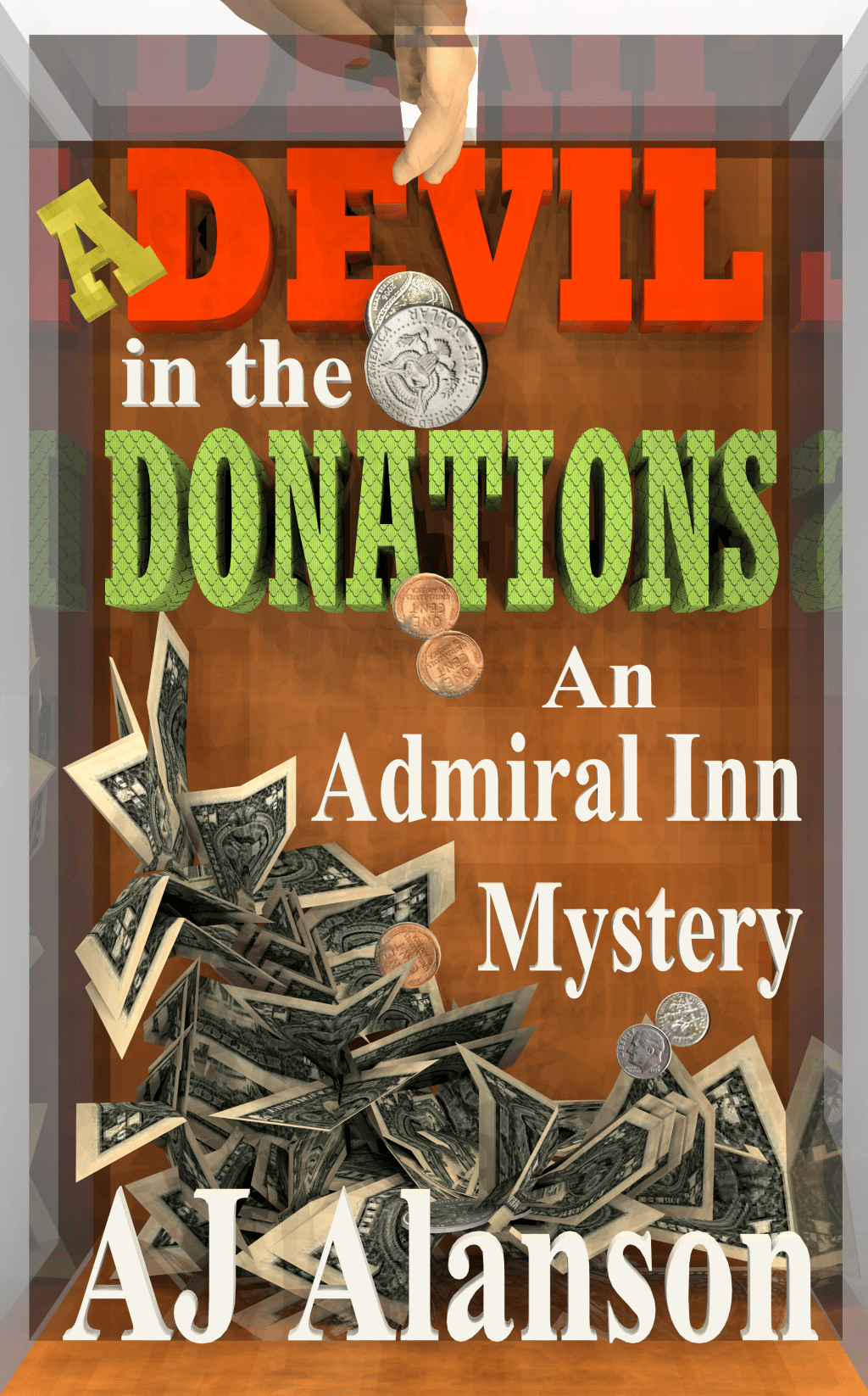
In the first book of The Admiral Inn Mystery series, A Devil in the Donations, an inanimate character is introduced that will appear in the subsequent books in the series. A $1,000 bill is anonymously dropped in a donation box for the annual community Thanksgiving Day banquet. At the end of the evening, the box is opened in the study amidst exhausted staff onlookers. The room is quickly cleared but for three Treasury agents: two active and June Faust, retired agent-turned-innkeeper. While these three set out to discover the life and times of this particular large denomination bill, few know the whole history of bills greater than $100—and it’s titillating.
The story begins in a young country tearing itself apart. In the 1860’s,Americans were using gold and silver coins to pay for common everyday fare, however, the government needed a means by which large amounts of money could be quickly moved around for the war effort. This led to two key inventions: the demand note (1861) and the United States Note (1862). Descending into war, this fledgling yet innovative country adopted the paper currency method used by a few banks at the time. Demand notes would be exchanged for gold or silver coins upon presentation at selected federal sites, but these sites began to run short of enough metal to meet demand within a year. This led to legislation and the issuing of the United States Notes. The US notes functioned the same as the current paper Federal reserve notes, not backed by metal but exchangeable anywhere for metal currency.(1)
However, all bills are not created equal. During the war, $500, $1,000, $5,000, and $10,000 notes were not meant for the population’s use, but for the government to move money between banks, government agencies, and military departments. (2) Understandably so, as in today’s purchasing power, those same bills would have redeemed ~ $10,000, $20,000, $100,000 and $200,000. (3) Imagine dropping that in the sewer grate while digging for coins for the parking meter, but the loss would be almost unfathomably worse because these are the “face” values of these notes. Due to its extreme rarity today, the $1,000 bill is highly collectible. A standard circulation note may sell for upwards of $2,800. A “Very Fine” 1928/1934 note might fetch as much as $2,500, and the Star Notes can reach as much as $30,000 per. Exceptional uncirculated specimens have sold for $100,000. (4)
But whatever you do if a $1,000 bill is dropped in the donation box, DO NOT REDEEM IT FOR $1,000! Yes, this is still legal tender. (5) The bank cannot refuse to honor it. The teller will politely break the bill and hand you back exactly $1,000 in current currency, but as of July 14th,1969, all denominations above $100 were discontinued (there’s a fascinating criminal component to this decision you really need to look up). Your bill will then be removed from circulation, logged, forwarded to the Treasury or Federal Reserve—and destroyed. (6)
This bill causes a ruckus for June that same night but its mystery takes her several books in the series to solve, and it’s blackmail.
¹ U.S. Treasury Historical Resource Center; Bureau of Engraving and Printing, History of U.S. Currency.
² Federal Reserve Bank of San Francisco, Currency Museum; Bureau of Engraving and Printing, denomination history.
³ U.S. Bureau of Labor Statistics, CPI Tables; MeasuringWorth.com, U.S. Purchasing Power Calculator.
⁴ Heritage Auctions, U.S. Currency Archives; Stack’s Bowers Galleries; U.S. Currency Auctions Price Guides.
⁵ Federal Reserve & U.S. Treasury Joint Announcement, July 14, 1969 (high‑denomination discontinuation).
⁶ Federal Reserve, Currency Handling Guidelines; Bureau of Engraving and Printing, Legal‑Tender Policy.






 A Well Seasoned Story
Leave a comment